
You are not overreacting.
Social media is hurting kids' brains, wellbeing, and futures.
The evidence is in. The pattern is clear. If we want to protect the next generation, we need to move early and move together.
more U.S. adolescents reported high depressive symptoms in 2015 than in 2010.
American teen girls were using social media more than 40 hours a week by 2015.
The U.S. Surgeon General warns that kids who spend more than three hours a day on social media face double the risk of depression and anxiety symptoms.
Start with these clips.
If you only have a few minutes, start here. These explain what changed, why it hit so hard, and what families can do next.
The charts broke fast
1:45A quick walk through the early-2010s break in teen mental-health data and why families felt the shift before institutions caught up.
The great rewiring
1:31Phone-based childhood did not replace a neutral baseline. It displaced play, friction, and face-to-face development.
Sleep is part of the fight
1:08The bedroom rule matters because the device does not only take attention. It takes recovery time too.
Keep these points in view.
If you are making decisions at home, at school, or around a first phone, keep these in view.
Childhood flipped faster than families could adapt.
The issue is not that kids suddenly became fragile. The environment changed on them between 2010 and 2015.
The first phone sets the pattern.
A first device can either train attention toward the real world or attach childhood to the whole app economy on day one.
Delay gets easier when it becomes a group norm.
Parents lose most battles alone. Shared rules across friends, classrooms, and families cut the pressure down fast.
There is a middle path between nothing and a full smartphone.
That is where Thrive helps. Calls, maps, music, and parent contact can come earlier without handing over social media and endless feeds.
Read the sources.
If you want to go deeper, start here. These are the studies, advisories, and evidence behind the claims on this page.
The Evidence
The Anxious Generation
Haidt and Zach Rausch's running evidence base on youth mental health, phone-based childhood, play decline, and the four norms.
Increases in Depressive Symptoms, Suicide-Related Outcomes, and Suicide Rates Among U.S. Adolescents After 2010
Clinical Psychological Science
Twenge, Joiner, Rogers, and Martin use nationally representative U.S. datasets to trace the early-2010s break and the stronger rise among girls.
Social Media and Mental Health
American Economic Review
Braghieri, Levy, and Makarin use Facebook's staggered college rollout as a natural experiment and find meaningful negative mental-health effects.
Social Media Use and Internalizing Symptoms in Clinical and Community Adolescent Samples
JAMA Pediatrics
A 2024 meta-analysis covering 143 studies found a positive association between social-media use and anxiety/depression symptoms in both clinical and community samples.
Social Media and Youth Mental Health
U.S. Surgeon General
The public-health advisory version of the case: nearly universal use, clear risk signals, and immediate steps for families and policymakers.
Parents are already pushing back.
More parents are delaying smartphones, backing phone-free schools, and choosing simpler first devices. That matters because this gets easier when families move together.
parents have signed the Wait Until 8th pledge, which explicitly allows a basic phone or watch for calls and texts while delaying smartphones.
families joined the Smartphone Free Childhood parent pact in eight months.
of UK schools were already covered by that pact when the group published its live count.
You need a next move. Not another lecture.
If the goal is to protect connection, sleep, attention, and family peace, there are three clean paths. Pick the one that matches where your family is right now.
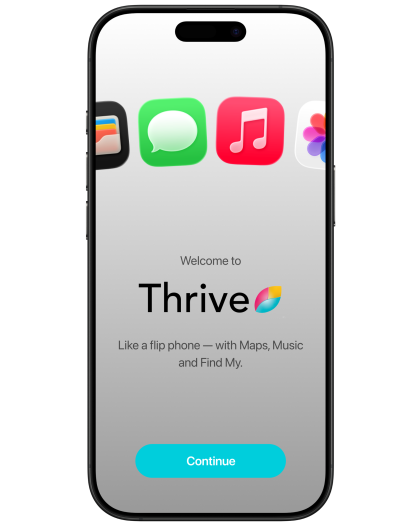
Start with contact. Skip the app store.
Turn an older iPhone into a kid-safe phone with calls, texts, maps, music, and essentials. That gets you connection without the whole internet.
See Just a Phone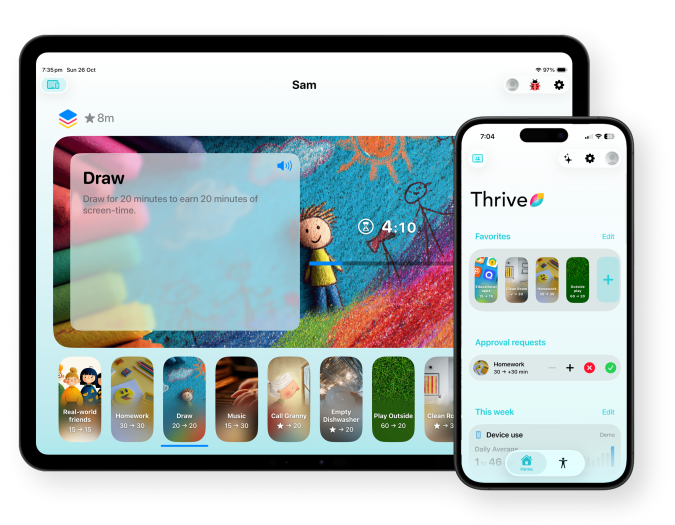
Keep the device. Change the pattern.
Use earn-based screen time to pull back the constant negotiation and make access depend on real-world activity again.
See Smarter Screen Time
Make the decision simpler.
Answer a few questions and get a cleaner recommendation based on your child, your rules, and what the phone actually needs to do.
Use Phone Finder